How Do We Understand The Economic And Racial Forces Behind The Inequities We See? How Might We Name The “System” In Which We Are Sitting? Analyzed Through The Lens Of Power.
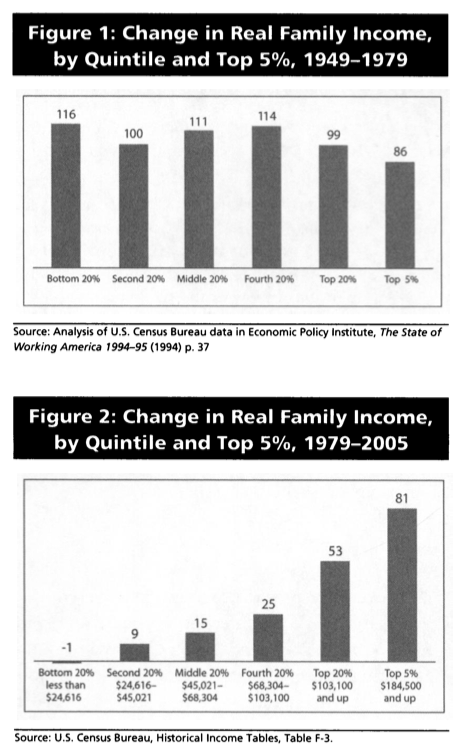
The current state of economic inequality did not come about overnight. In fact, the three decades proceeding World War II showed inequality in decline. This trend toward “shared prosperity” stopped in the mid-1970’s as corporations and the wealthy strongly increased their influence and power over politics in what has been called the nation’s “great U-turn”. The deregulation of the financial system, coupled with the Supreme Court ruling that government may not ban election spending by corporations, has allowed the wealthy to use their power to shape our democracy into a system which Senator John McCain described as “an elaborate influence-peddling scheme by which both parties conspire to stay in office by selling the country to the highest bidder.” (Goldberg, 2012, p.211, 216).
I asked Jon Talton, Economy Columnist at the Seattle Times for his thoughts on this concept. He replied “Inequities have existed in every society in history, including and especially in communist states. Today’s America remains full of opportunity and less de jure discrimination than any time in history. The rub is that since the late 1970s the super-rich have been pulling away, while the fruits of the economy are less evenly shared than the era from the 1940s through the 1970s. Racial issues inform some of this. For example, a century of Jim Crow hurt the ability of blacks to build and pass along intergenerational wealth. But progress is undeniable, too, including the rise of a large black middle class.” (Talton, 2019)
The following graphs illustrate the changes in income distribution in the decades following World War II, as well as after the great U-turn in the 1970’s.
Dr. Lisa Citron, economics professor at Cascadia College, sees the issue of inequality in America as a class-based problem. Speaking about the idea of how to succeed in the U.S. she said “in order to get ahead you need to go to college, but who goes to college?” Comparing privileged well-off students to those from poorer schools with less resources, one of the things she found were students from low income schools who had the desire to attend a program like engineering, only to find they couldn’t qualify because their schools lacked necessary classes like AP Calculus that they would need to be fluent in to succeed. Talking about wealthy entitlement and the recent college admissions scandal she says “Why do these rich people from Hollywood feel the need to do that? They’ve already got so much money, what’s the point?” (Citron, 2019)

Looking at the state of our economy, and the composition of our current government, I would describe our “system” as a very obvious plutocracy. We have a billionaire president, with a cabinet full of other billionaires and millionaires, and many if not most of our members of congress are also millionaires. Is it surprising that one of the only substantial pieces of legislature they’ve been able to pass was tax reform that mainly benefitted their own class? Takaki (2008) illustrates this system in action all the way back in 1861, noting “The Civil War was initiated by the planter class of the South. Although they constituted only 5 percent of the southern white population, the slaveholders were dominant in politics. Defending their profitable “peculiar institution,” this ruling elite took their states out of the Union” (15). This analogy is particularly disturbing when combined with Jon Talton’s statement that “We’re more divided now than any time since the eve of the Civil War and few minds are being changed.” (Talton, 2019)
In 2002, former Nixon advisor Kevin Phillips described “the relentless takeover of U.S. politics and policymaking by large donors to federal campaigns and propaganda organs,” signaling plutocracy’s emergence and the hamstringing of a democratic government’s ability to reduce economic inequality through policy. For example, in the early 1970’s only a few Fortune 500 companies employed lobbyists in the District of Columbia, but by decade’s end that number rose to 80 percent. (Goldberg, 2012, p.215- 216).
With government in their control, those in power turned their attention to media, where between the years 1983 and 2004 the number of corporations controlling most mass media shrank from 50 to five, leading media watchdog Fairness and Accuracy in Reporting (FAIR) to hold that “mergers in the news industry have accelerated, further limiting the spectrum of viewpoints that have access to mass media.” And of course the viewpoint projected by the media was the viewpoint of its owners. (Goldberg, 2012, p.217). Further supporting this argument, Postman (2006) writes “The Constitution was composed at a time when most free men had access to their communities through a leaflet, a newspaper, or the spoken word…But the Founding Fathers did not foresee that tyranny by government might be superseded by another sort of problem altogether, namely, the corporate state, which through television now controls the flow of public discourse in America” (139).
Power, as defined by Black’s Law Dictionary (2011) is “an authority to do some act in relation to real property, or to the creation or revocation of an estate therein, or a charge thereon, which the owner granting or reserving such power might himself perform for any purpose.” In a plutocracy, power is derived from wealth, and in the actions displayed by the wealthy elite in their attempts to control policy and public opinion, there is a clear connection to this definition of power. They create corporations, political action committees, and monopolize news outlets. They hire lobbyists and charge them with swaying politicians to vote in their favor. Having access to obscene amounts of resources, they are able to not only use their power for controlling the economy, but ensuring they are able to remain in power and continue to do so indefinitely.
As the power of these lobbyists grew, their influence over legislators led to a series of deregulating policies that brought the nation to disaster. One case in particular, Marquette Nat. Bank of Minneapolis v. First of Omaha Service Corp, permitted lenders in states with liberal interest-rate ceilings to lend to consumers in states with more conservative rates, causing credit cards to be granted to people who otherwise wouldn’t have qualified, leading to a huge increase in personal bankruptcies. This paved the way to predatory lending and the subprime mortgage scandal that rocked the U.S. economy and sent it into a years long recession. As part of this practice “some buyers who were qualified for conventional terms were nonetheless induced to take out subprime mortgages because the interest rates on those were higher. African Americans were targeted by predatory lenders. In fact, middle-class African American neighborhoods had higher rates of subprime mortgages than poor white neighborhoods. (Goldberg, 2012, p.218-219)
President Obama (2013) assumed office in the midst of this recession and made battling economic inequality one of his top priorities, saying “the combined trends of increased inequality and decreasing mobility pose a fundamental threat to the American dream, our way of life, and what we stand for around the globe…I believe this is the defining challenge of our time”. With control of the media, those in power fought back, not wanting to cede their power or assets to Obama’s efforts. They labeled his attempt to narrow the divide as “class warfare” and exerted enough pressure on congress to split the democratic congress, forcing him to focus his efforts elsewhere.
Senator Marco Rubio (2011) once made a speech in which he said “We have never been a nation of haves and have-nots. We are a nation of haves and soon-to-haves. People who have made it, and people who will make it. Supporting this line of thought was a Pew Research Poll taken a few years after the end of the Great Recession which found: 65% believe the gap between the rich and everyone else has increased in the last 10 years. By a 60% to 36% margin, most Americans feel the economic system unfairly favors the wealthy. And “60% say most people who want to get ahead can make it if they’re willing to work hard (Pew Research Center, January 2014). Despite the evidence against it, it seems that most Americans believe that hard work is all it takes to rise to the top. Ronald Wright (2019) quotes John Steinbeck as telling him “socialism never took root in America because the poor see themselves not as an exploited proletariat, but as temporarily embarrassed millionaires. This helps explain why American culture is so hostile to the idea of limits, why voters during the last energy shortage rejected the sweater-wearing Jimmy Carter and elected Ronald Reagan, who scoffed at conservation and told them “it was still morning in America”. No where does the myth of progress have more fervent believers” (124).
Solving these inequalities is not in the scope of this writing, nor is it simple enough to merely sit down and pen a solution. However looking at the causes of these problems, the histories associated with them, and recognizing the forces that drive them, allows us to at least notice and be cognizant of what’s happening. Our elected representatives should be held accountable and removed when they fail to stand up for those who elected them, and bow to the corrupt power of the wealthy. Our financial institutions should be monitored and regulated to prevent them from taking advantage. Media should be held to account for false narratives, and not just by angrily yelling “fake news”. In all cases proportionate fines and criminal prosecutions need to be implemented when justified to maintain the integrity of both our economy, and our democracy.
Resources
Citron, L. (2019, July 29). Group Interview of Lisa Citron [Telephone interview].
Goldberg, G. S. (2012). Economic Inequality and Economic Crisis: A Challenge for Social Workers. Social Work, 57(3), 211-224. doi:10.1093/sw/sws005
Pew Research Center, January 2014, “Most See Inequality Growing, but Partisans Differ over Solutions”. (n.d.). Retrieved from https://www.pewresearch.org/wp-content/uploads/sites/4/legacy-pdf/1-23-14-Poverty_Inequality-Release.pdf
Postman, N. (2006). Amusing ourselves to death: Public discourse in the age of show business. New York, NY, U.S.A.: Penguin Books.
Remarks by the President on Economic Mobility. (n.d.). Retrieved from https://obamawhitehouse.archives.gov/the-press-office/2013/12/04/remarks-president-economic-mobility
Rubio: “We Are A Nation Of Haves And Soon-To-Haves”. (n.d.). Retrieved from https://www.rubio.senate.gov/public/index.cfm/2011/12/rubio-we-are-a-nation-of-haves-and-soon-to-haves
Talton, J. (2019, July 29). Interview of Jon Talton, Seattle Times [E-mail interview].
Takaki, R. T. (2008). A different mirror: A history of multicultural America. Boston: Little-Brown.
What is POWER? definition of POWER (Black’s Law Dictionary). (2011, November 04). Retrieved from https://thelawdictionary.org/power/
Wright, R. (2019). A short history of progress. Toronto: House of Anansi Press.
 Economic System